- The shipping industry is very important, yet traditional, manual and complex;
- Hotels, tickets, taxis are online, but freight is not (despite numerous attempts);
- The technology for online booking or price comparison has been available for many years.
Freight forwarding looks like a perfect industry for disruption! A cohort of digital freight forwarders and freight marketplaces emerged on the market. Their value proposition can be summarized as Booking.com for shipping. And yet, today in 2017, it is still hardly possible to find and compare freight rates online. Although some digital freight platforms enable online bookings, there is still a lot of manual work behind the digital interface.
The Complexity of Freight Rates
It’s never been easy to deal with freight, due to the freight rate complexity and volatility. Looking at the whole end to end process, it seems logical that transportation price consists of multiple components because the cargo literally travels half of the globe one way. Adding all transportation costs into the picture (door delivery, customs, port expenses), makes ALL-IN freight rate calculation a very complicated process.
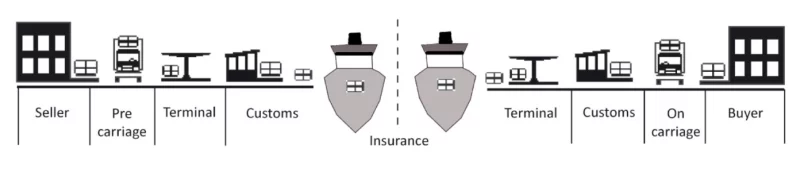
Let’s look at a typical ocean shipment example – a container with shoes is shipped from a factory near Beijing, China to a warehouse in Warsaw, Poland.
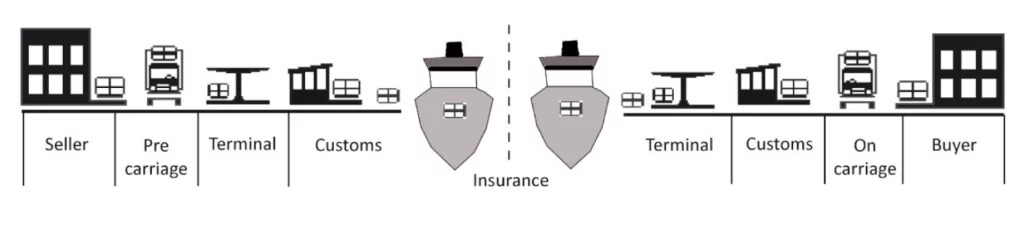
A freight forwarder has to organize the following:
- Container depot in Beijing, China – releases empty container to the exporter;
- A trucking company in China – picks up the empty container and delivers to the factory
- Shoe manufacturer in Beijing, China – loads goods in a container;
- A trucking company in China – delivers the container to the port;
- Customs office in Xingang, China – inspects and seals the container;
- Port of Xingang, China – loads container on the ship;
- Ocean shipping line – delivers container from China to Poland;
- Port of Gdańsk, Poland – discharges container from the ship;
- Customs office in Gdańsk, Poland – inspects and clears the container;
- Railway operator in Poland – delivers container from the port to Inland Depot;
- Inland Depot in Poland – releases container to the importer;
- A trucking company in Poland – delivers the container to the importer;
- Importer in Warsaw, Poland – receives and unloads container;
- A trucking company in Poland – delivers the empty container to the Inland Depot.
After adding here also banks and insurance of the goods, we end up with a minimum of 16 interactions between 14 different business parties, including the state-regulated ones. All these parties are mostly independent entities, not connected to each other. For the industry digitalization to happen, all these parties must be digitally linked into one smooth supply chain, globally.
Booking.com for Shipping
Coming back to the ‘Booking.com for shipping’ analogy: hotel booking platforms connect the property owners with travelers. Travelers book online and don’t negotiate. This analogy from the B2C model can’t work for the B2B business world.
The ‘travel agency‘ analogy would be more suitable here but still offers its limitations. Travel agencies negotiate deals with suppliers, but the client of the travel agency is again a traveler (B2C). For freight forwarders, both their suppliers and their customers are B2B companies. And their customers’ customers are B2B companies. Hotel or ticket booking doesn’t remotely compare to the freight transportation in terms of complexity.
For decades, traditional freight forwarders took care of complex logistics and supply chain management. They have connections to the suppliers, agents, customs, and they take care of the entire shipment process, including that cargo insurance. The human factor plays a big role in this mostly relationship-driven business.
Traditional players are faced with a tough trend – strong demand from the market for simplification and digitization. But even the most advanced digital freight forwarders have to employ a large team in their back office, who has to deal with the complexity of the actual logistics.
Digital Solution for the Industry
At Quotiss, we recognize that the demand for digitalization is, in fact, demand for simplification and efficiency. The technology itself can’t fix the broken process. Quotiss software has a smart algorithm, which simplifies freight rate management and automates the quoting of freight rates. Quotiss software helps traditional freight forwarders to become digital.
Click here to register your company. We’ll activate your company’s profile and help with the initial settings and user onboarding. You can start uploading your freight ratesheets and quoting freight from Quotiss on the same day we sign the deal.